Workforce Planning in an Era of Rapid Automation: What HR Needs to Own
In an environment where automation is reshaping job roles faster than organizations can track, headcount planning misses almost everything that matters.
At HR-AI Fusion, we work with HR leaders and growing organizations to build the planning capability the next phase of work demands.
This week the series moves into the Operations cluster, which looks at how HR actually works: planning, governance, implementation, and change. We start with the planning conversation most organizations are having in the wrong way.
Ask ten HR leaders what workforce planning means and you will get ten different answers. Some will describe it as a headcount exercise. Others will talk about succession planning or org design. A few will mention talent pipelines. Most will agree it is important and most will quietly admit their organization does not do it well.
The confusion is understandable. Workforce planning has historically been treated as an annual process tied to budget cycles, producing a document that estimates how many people the organization needs by function and level. It has been useful as a financial planning tool, but it has rarely been strategic in any meaningful sense.
What Workforce Planning Actually Is
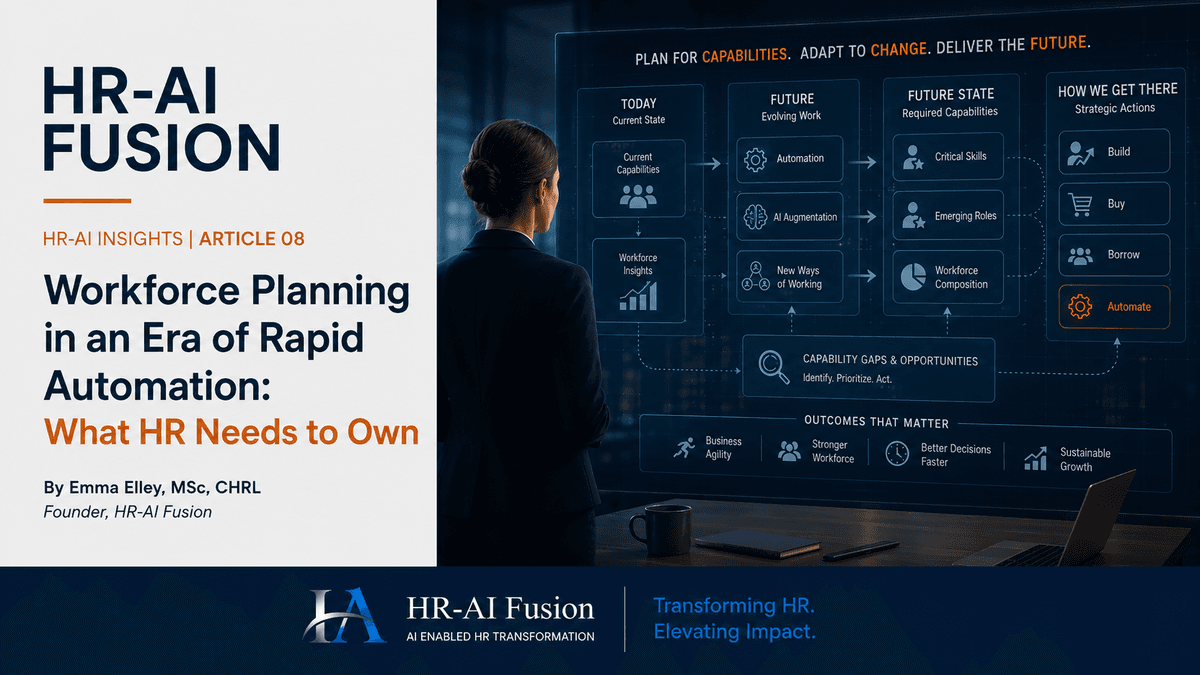
At its core, workforce planning is the process of understanding what capabilities the organization needs to execute its strategy, when it needs them, and how it intends to build, buy, borrow, or automate its way to having them.
That definition is broader than most organizations practice. It encompasses not just how many people are needed, but what those people need to be able to do, how long those capabilities will remain relevant, where the gaps are today, and what the realistic pathways are for closing them. It is fundamentally a strategic conversation about the future of work inside a specific organization, not a spreadsheet exercise about next year's hiring budget.
Done well, workforce planning connects talent strategy to business strategy in a way that makes both more credible. It forces the organization to be honest about where it is heading, what it will take to get there, and whether the current workforce is positioned to deliver. Done poorly or not at all, it leaves the organization reacting to capability gaps that were entirely predictable and making expensive decisions under pressure that better planning would have avoided.
Why Automation Changes the Picture
The reason workforce planning has become more urgent is not that automation is eliminating jobs wholesale, though in some roles and sectors it is doing exactly that. The deeper disruption is to the stability that traditional workforce planning assumed.
Previous generations of workforce planning could reasonably work on multi-year horizons. Skills took years to become obsolete. The nature of a role was relatively stable across a planning cycle. The ratio of human to automated work in any given function changed slowly enough that organizations could adapt through normal turnover and hiring patterns.
That stability is gone. Automation is now changing not just which tasks are done by machines, but which tasks are worth doing at all, and what the remaining human work actually requires. A workforce planner working on a three-year horizon today is making assumptions about the shape of roles that may look significantly different within eighteen months. The skills gap that feels manageable now can become acute quickly, because the capability demand is shifting faster than the supply of trained people.
This creates a planning problem that traditional approaches were not designed to solve. It requires organizations to plan for a range of scenarios rather than a single projection, to update their workforce model more frequently, and to think carefully about the difference between capabilities that are genuinely durable and roles that are more exposed to automation than current planning assumes.
What HR Brings to the Conversation
Workforce planning in most organizations is already happening in some form. Finance is modelling headcount as part of the budget. Operations is thinking about capacity and throughput. Leadership is making assumptions about the shape of the business in twelve and twenty-four months. These are not wrong conversations. They are simply incomplete ones.
What is often missing is the capability lens. Finance and Operations are well-positioned to model cost and output. They are less naturally positioned to think about the human dimensions of capability building: how long it realistically takes to develop skills that cannot be hired immediately, which roles are genuinely exposed to automation versus which ones are more durable, the cultural conditions that affect whether people can absorb change at the pace the business needs, or the governance questions that arise when automated systems start making decisions that used to belong to people.
This is where HR adds something the planning conversation would otherwise lack. Not by displacing the financial or operational view, but by broadening it. The organizations that make the best workforce planning decisions are the ones where HR is a genuine contributor to the strategic conversation rather than a downstream recipient of decisions already made. That requires HR to show up with data, a point of view, and a willingness to connect people strategy directly to business outcomes.
Where to Start
Most organizations do not need a sophisticated workforce planning function on day one. They need to start having the right conversations, which means connecting the dots between where the business is heading, what that implies for the shape of the workforce, and where the most significant gaps and vulnerabilities are.
A practical starting point is a capabilities audit: an honest assessment of what the current workforce can do, what the strategy demands, and where those two pictures diverge. That audit does not need to be exhaustive to be useful. Even a high-level view of where automation is already changing the work, where the skills demand is growing, and where the pipeline of talent is thin gives HR the foundation to have a more credible strategic conversation with leadership.
From there, workforce planning becomes a continuous process rather than an annual event, one that HR updates as the business evolves and as the automation picture becomes clearer. The organizations that get ahead of capability gaps are not the ones with the most sophisticated planning models. They are the ones that started the conversation early enough to have real options when the gaps became urgent.