HR's AI Literacy Challenge
Organizations are getting the order wrong. The tools are going in before the capability is built, and HR is the function carrying the consequences.
At HR-AI Fusion, we work with HR leaders and growing organizations to close that gap before it becomes a crisis.
There is a particular irony in how AI is landing in most organizations right now.
HR is being asked to manage the people side of AI adoption: the workforce planning, the change management, the training programs, and the employee communications. In many organizations, HR is the function expected to bring everyone else along.
And HR, in many cases, has not been brought along itself.
The Gap That Is Not Being Talked About
The numbers from Canada make the problem concrete.
KPMG's 2025 Generative AI Adoption Index found that 51 percent of Canadian employees now use generative AI at work. Of those, 83 percent say they want or need to upskill to use it more effectively. Yet only 48 percent say their employer has provided sufficient training to do so. Adoption is rising. The need for support is rising faster. The investment is not keeping pace.
For HR teams specifically, the implication runs deeper than it does for most functions. On June 1, 2026, the federal government released a draft of Canada's national AI strategy with a central commitment to providing all Canadians access to free AI literacy training. When the federal government makes national AI literacy a strategic priority, it is telling every organization in the country that baseline AI competency is no longer optional. For HR leaders, the bar is higher still. You are not just expected to meet that baseline. You are expected to be ahead of it, to be the people employees and leaders come to with questions about AI at work, not the people quietly hoping nobody asks.
And there is a harder number beneath all of this. KPMG also found that 93 percent of Canadian organizations report enterprise-level AI adoption, yet only 2 percent say they are realizing a measurable return on their AI investments. That gap between deployment and value does not close by buying better tools. It closes when the people using those tools have the literacy to use them well.
What We Mean When We Say AI Literacy
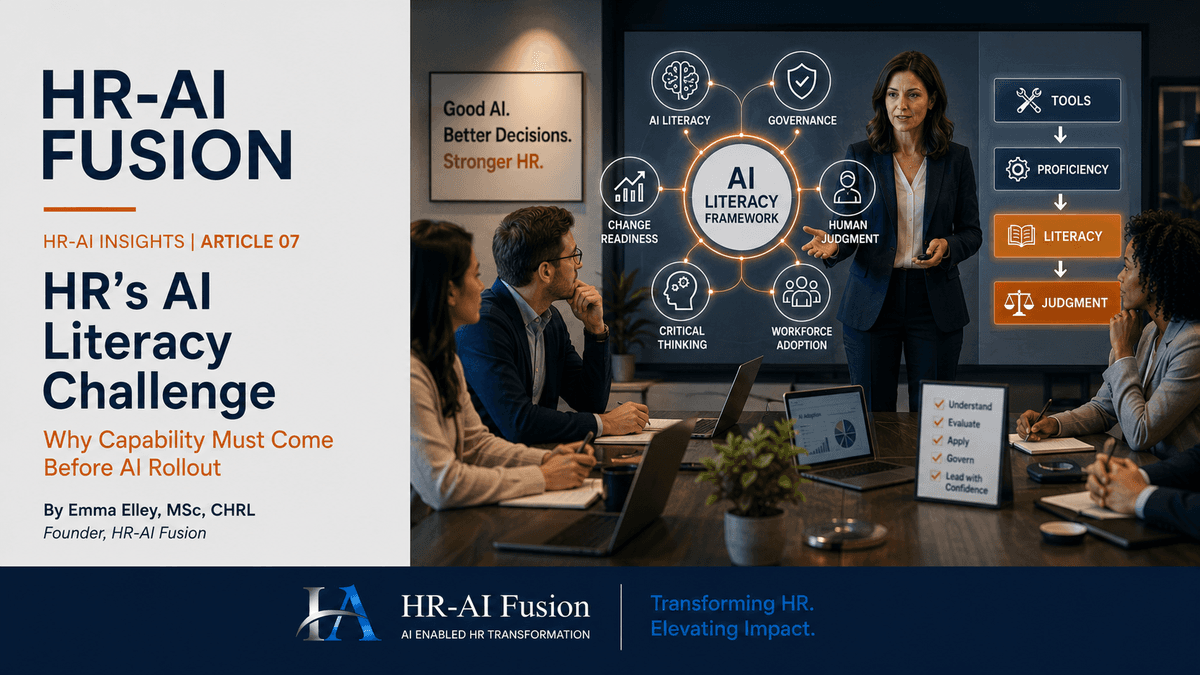
AI literacy is not the same as AI proficiency, and the distinction matters more than it might seem.
Proficiency means being able to use AI tools effectively. Writing good prompts, reviewing outputs critically, knowing when to iterate and when to start over. These are learnable skills and they improve quickly with practice.
Literacy is something broader. It means understanding what AI is actually doing at a process level, what the governance implications are, where accountability sits when things go wrong, and how to make sound decisions about where AI should and should not be used in HR work.
A team can be proficient without being literate. They can produce consistent, high-quality AI outputs without having the conceptual foundation to exercise judgment when something unexpected happens, when a result does not feel right, or when a decision needs to be escalated rather than automated.
In HR, literacy is what matters more. The stakes of getting AI wrong in HR, in hiring, in performance, in employee relations, are not the same as getting it wrong in a marketing email.
Why Training Programs Are Not Enough
The instinctive response to a literacy gap is a training program. Book a session, run the team through it, tick the box.
The KPMG data exposes exactly why that approach fails. Of Canadian employees who received AI training, 36 percent never used it because they were too overwhelmed to implement new work processes. Another 37 percent started using AI after training but stopped for the same reason. That means nearly three quarters of people who go through AI training end up exactly where they started, not because the training was poor, but because training alone does not address the structural conditions that make adoption difficult.
AI is also not a skill you learn once. The tools change every quarter. The capability shifts every month. A one-time session builds familiarity with a specific tool at a specific moment. It does not build the judgment, the governance instinct, or the conceptual foundation that literacy actually requires.
What HR teams need is not a workshop they attend once. It is a structured way of building the kind of thinking that survives tool changes, because the tools will keep changing. That means learning to evaluate outputs rather than just generate them. Learning to ask whether AI should be used in a given situation, not just how. Learning to recognize where the human judgment layer sits and to feel confident exercising it, even when the tool is producing something that looks plausible.
What Literacy Looks Like in Practice
An HR team with genuine AI literacy looks different from one that has simply been handed tools and told to use them.
They ask different questions before an implementation starts. They push back when governance structures are absent. They notice when an output does not align with policy even if it looks professionally written. They know which tasks genuinely benefit from AI and which ones lose something important when the human element is removed.
They are also, notably, less anxious. One of the less-discussed consequences of inadequate AI literacy is the quiet dread that many HR practitioners are carrying into work every day. The sense that the tools are moving faster than their ability to keep up, that they are expected to lead something they do not yet understand, and that admitting that carries professional risk.
That anxiety is not a personal failing. It is a reasonable response to being given responsibility without preparation. Literacy, built properly, resolves it, not by making everything simple, but by giving people the conceptual ground to stand on.
Where the Workshop Series Fits
The HR-AI Workshop Series was built to close that confidence gap. The focus is practical: helping HR practitioners understand how AI works in an HR context, what good output looks like, and how to work with purpose-built HR tools in a way that is consistent, accountable, and grounded in sound judgment.
The free introductory session is the right place to start for teams who are curious but have not yet found a practical entry point.
The half-day workshop builds working confidence with HR-specific AI tools and the governance principles that sit behind them.
The four-week cohort goes deeper, covering the full picture from readiness through to change management and long-term adoption.
If your team is carrying the weight of AI adoption without having had the investment that should come with it, the series is designed for exactly that situation.