Why Your HR Team Is the Most Important Variable in Any AI Implementation
Your HR team is the most important variable in any AI implementation. Not the technology, not the budget, and not the vendor. The people on your HR team and whether they have been set up to lead this change, or simply handed the controls and expected to figure it out.
At HR-AI Fusion, we work with HR leaders and growing organizations to close that gap before it becomes a crisis.
Last week's piece was about what strong performers tell you when they go quiet, and what it costs when organizations do not listen early enough.
This week is about the variable that determines whether an AI implementation in HR succeeds or quietly fails. It is not the technology, not the budget, and not the vendor. It is your HR team.
The Variable Nobody Puts in the Risk Register
Every AI implementation conversation eventually arrives at the same moment.
The vendor has finished their demo. The slides have been tidy and compelling. The ROI projections look promising. And someone in the room, usually in Operations or Finance, asks the question they have been holding since slide three:
“So how do we roll this out?”
What follows is almost always a conversation about technology, the integration timelines, data migration, sometimes change management communications, then go-live dates.
What rarely follows is a conversation about the people who will actually make it work, and their bandwidth. Those people are your HR team, and in my experience, they are the most underprepared part of any AI implementation, not because they are not capable, but because no one has invested in getting them ready.
When organizations implement AI into HR functions, they spend considerable time assessing technical readiness. Is the data clean? Are the systems compatible? Do we have the right security protocols? These are legitimate questions, but they are not the hard ones.
The hard question is this: does your HR team have what it takes to lead this transition, not just survive it?
HR teams across Canada are being handed AI tools with the implicit instruction to become more efficient, more strategic, and more data-driven, often without additional headcount, proper training, or a clear picture of what good looks like once the tool is embedded. That is not an implementation plan. It is a pressure test with a vendor invoice attached.
When implementations falter, and many do, the diagnosis is usually framed as a technology problem or a change management problem. It is often neither. It is a people problem that was never properly named. The HR team was not ready, not supported, or not honest about what they were actually facing.
What Readiness Actually Looks Like
Genuine readiness is not enthusiasm, and it is not training completion. A team can be genuinely excited about AI and still be completely unprepared for what it demands of them. Finishing a vendor onboarding module does not mean someone can exercise sound judgment when the tool produces a result that does not feel right. Genuine readiness has three components that I look for when working with organizations.
Conceptual clarity means the team understands what the tool is actually doing at a process level, not just a technical one. They can explain to an employee why a decision was made and what recourse exists if they disagree.
Psychological safety means there is space to raise concerns without being read as resistant. The team members most likely to catch a problem early are often the ones least likely to speak up in a culture that is fast-moving and optimistic about the rollout.
Operational ownership means HR is driving the implementation rather than being delivered to. There is a meaningful difference between a team that shaped the process and one that was handed a go-live date, and that difference shows up clearly when things get difficult.
These are not things that happen by accident, and they are not things a vendor onboarding module can build. They require deliberate investment in your team before the technology goes live.
The Cost of Skipping This Step
AI in HR touches policy and processes, performance, hiring, and employee experience. When AI-assisted decisions go wrong in these areas, when a bias goes unchecked or an employee receives an inaccurate result and no one catches it, the damage is legal, reputational, and deeply personal for the people affected.
HR leaders carry professional accountability for the integrity of these processes, and that accountability does not transfer to the vendor when the contract is signed. It stays with your team. That is precisely why readiness is not a soft consideration. It is a governance issue.
What We Are Doing About It
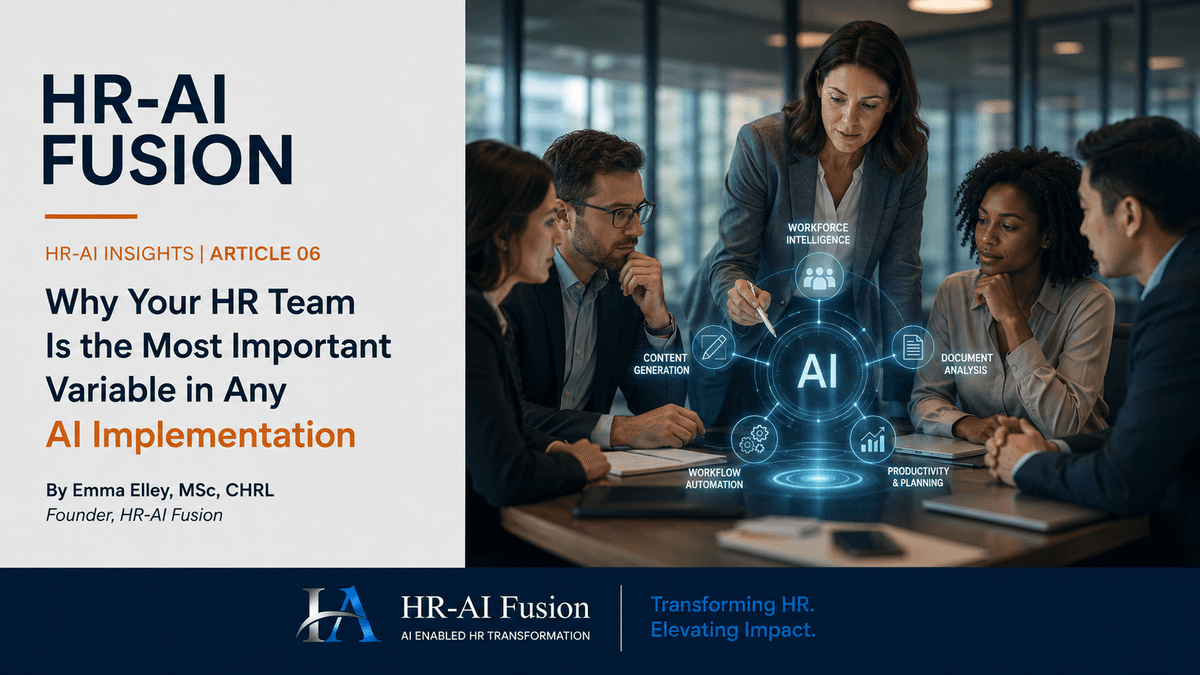
Over the past several months, I have been developing a workshop series specifically for HR practitioners navigating this transition. Not a vendor roadshow and not a general AI literacy course, but a practical, HR-specific program built around the five areas where AI is actually changing how HR teams work: content generation, workforce intelligence, document analysis, workflow automation, and productivity and planning.
The series runs at three levels so organizations can start where they are.
The free introductory session is a 60 to 90 minute online workshop that gives HR teams a map of where AI applies in their work and a hands-on prompt exercise they can use the same week. No prior AI experience is needed.
The half-day workshop goes deeper into implementation, with a focus on purpose-built HR tools, governance principles, and how to build consistency across your team so that AI output meets a professional standard every time, not just when someone writes a good prompt.
The four-week cohort is for HR leaders who want to work through AI adoption in a structured way, covering the full picture from readiness assessment through to change management, workforce planning, and long-term governance.
The Bottom Line
AI will reshape how HR works, and that is not in question. What is in question is whether your HR team is being set up to lead that change thoughtfully, or simply handed the controls and expected to figure it out off the side of their desk.
The organizations that get this right will not be the ones with the most sophisticated technology. They will be the ones that invested in their people before they invested in their platforms.
The hardest part is not picking the technology. It is being honest about how ready your team actually is.