
The Retention Problem Most Organizations Are Too Late to See
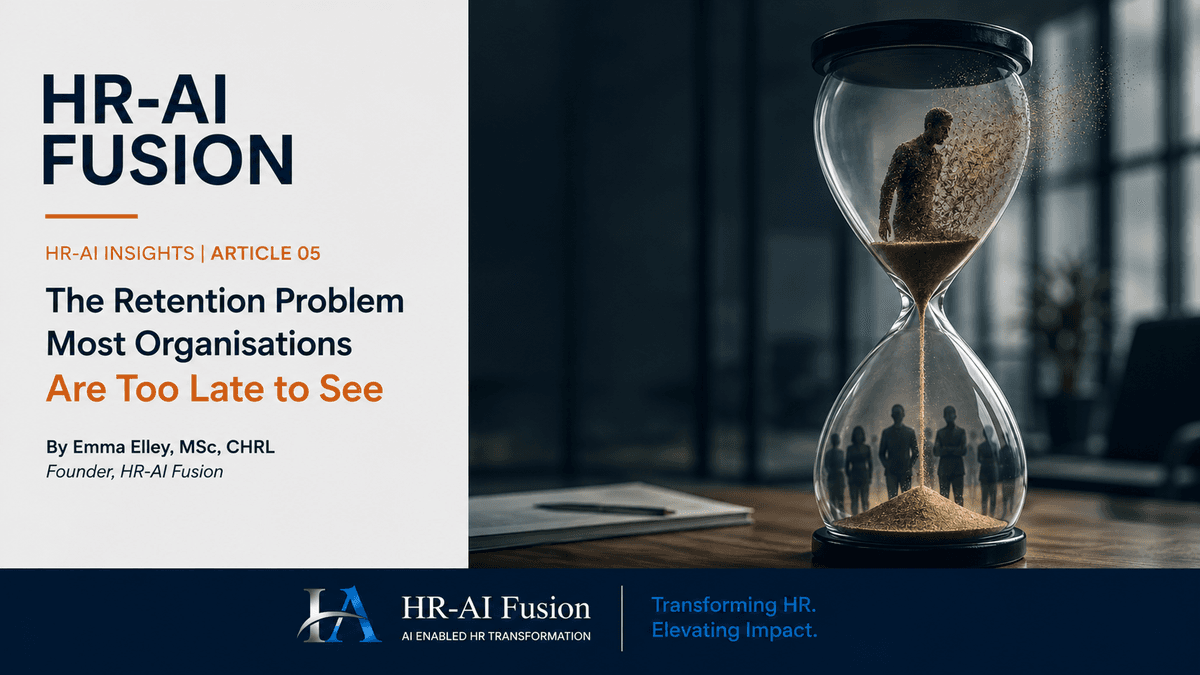
When culture breaks down, the first thing organizations lose is not people. It is the part of those people that went beyond what was required of them. The discretionary effort, the initiative, the investment in outcomes beyond their own job description. That disappears long before anyone resigns.
At HR-AI Fusion, we work with organizations to surface this picture clearly before the cost becomes a crisis.
The Damage You Cannot See on a Spreadsheet
Most organizations measure retention by who leaves. That is an understandable starting point, but it only tells part of the story.
The more consequential question is what the people who are still there have already stopped giving, and why.
Poor culture does not just cost you the people who leave. It costs you a piece of everyone who stays.
Discretionary effort is where organizational performance actually lives. It is the person who notices a problem before it becomes a crisis and says something. The leader who invests in their team not because it is in their job description but because they are genuinely committed to the outcome. The specialist who brings an idea that changes how something works. The new hire who builds relationships because they want to be part of something, not just employed by it.
When culture erodes, that is what goes first. And because it disappears gradually and without resignation letters, organizations often do not realize it is gone until they are trying to understand why performance has plateaued, why decisions are taking longer, why innovation has slowed, or why everything costs more effort than it used to.
The people are present. The capability is technically there, however the will to use it fully has been withdrawn, and nobody sent an email to say so.
What fills the gap is often the opposite of what the organization needs. People who were never going to leave anyway, not because they are deeply committed but because they are comfortable. People who have quietly adapted to a culture that rewards compliance over contribution. The organization's centre of gravity shifts in a direction that compounds over time, and by the time it registers in any formal measure, it has already been operating that way for a long time.
At the Heart of Most Culture Breakdown Is Leadership
When you look closely at organizations experiencing this kind of erosion, the pattern is consistent. The cause is rarely a flawed strategy, a restructure that did not land well, or a difficult market. It is leadership: the daily behaviour of the people in charge of other people, and the culture that behaviour creates over time.
If there are some leaders in the organization who are controlling, dismissive, or develop a pattern of pushing out strong performers who ask difficult questions or offer a different point of view, the damage radiates far beyond the individuals directly involved. Every person who witnesses what happened draws their own conclusions about what is and is not safe in this organization, and they adjust accordingly.
People stop raising concerns and ideas stop being shared. The honest conversations move elsewhere because experience has taught people that having them in the room carries a cost. Problems that could have been caught early persist until they become serious, because nobody wanted to be the one who said something.
Meanwhile the leader, increasingly surrounded by people who have learned to reflect their perspective back to them, develops a confidence in their own judgment that is no longer grounded in an accurate picture of what is actually happening. The gap between what leadership believes and what the organization is experiencing widens. The people with the most to offer, and the most options, begin to quietly recalibrate.
Some of them leave, however others stay and make a rational and entirely understandable adjustment: they stop giving everything. They do their job and they meet their obligations, however the investment beyond the defined role, the initiative, the care about outcomes, the willingness to go further than required, is withdrawn.
This is not about blaming individuals. It is about recognizing that leadership behaviour, particularly from the top, sets the conditions for everything beneath it. If those conditions are poor, the cost is borne by the whole organization, not just the people who eventually hand in their notice.
The Gap That Makes This Hard to Fix
One of the most consistent barriers to improving culture is the gap between what leadership believes is happening and what employees are actually experiencing.
Leaders often sense something is wrong before they can name it. Departures feel non-random, and survey results do not match what people are saying privately. Experienced, capable people are leaving for roles that are not obviously better. The instinct is usually right, however what is missing is a clear enough picture to know where to start.
What organizations typically lack is not effort or good intentions. It is honest self-knowledge: a structured understanding of where their culture is creating risk, across which areas, and with enough clarity to decide what to address first.
That is the gap the Culture & Retention Diagnostic™ is designed to close. It sits at the start of our Strategic Advisory work as the foundation for understanding the organization as it actually is, not as leadership assumes it to be. Because before anything can genuinely improve, you need an honest picture of where you stand.
What Poor Culture Actually Costs
The cost of a culture that is eroding is not primarily financial, though financial it certainly is. Recruitment, onboarding, and lost productivity from departures are real and measurable, however the deeper cost is organizational.
Slower decisions, lower quality outputs, reduced innovation, weakened team cohesion, and a gradual decline in the organization's ability to respond to challenge and change. Projects that stall not because people lack the skills but because nobody is sufficiently invested to push through the barriers. Meetings where the real conversation happens afterwards, in the parking lot, because experience has taught people that honesty in the room carries a cost.
These are not soft costs, they are the conditions that determine whether an organization can execute its strategy, sustain its performance, and hold on to the people capable of driving both.
The Seven Areas the Diagnostic Examines
Leadership culture sits at the root of most retention and engagement problems, however it does not operate in isolation. It shapes, and is shaped by, the broader culture across seven interconnected areas. The Culture & Retention Diagnostic™ examines all seven, because addressing leadership alone without understanding the full picture rarely produces lasting change.
1. Leadership Culture
This is the primary driver. When some leaders are controlling, dismissive, or have a pattern of marginalizing strong people who challenge the status quo, the effects are not contained to the individuals involved, they affect every person who observes what happened and draws conclusions about what is safe here.
Psychological safety erodes and discretionary effort contracts. The leader, surrounded by people who reflect their views back to them, becomes increasingly confident in a picture of the organization that is no longer accurate.
This area examines whether leaders are genuinely accountable for the engagement and wellbeing of their people, whether employees feel safe raising concerns, and whether strong performers are protected rather than sidelined.
2. Growth & Development
People disengage and leave when the future they were expecting has quietly closed. The problem is not always a shortage of training programs. It is often something more subtle: programs exist, however genuine investment in people's growth does not.
People working for leaders who do not champion their growth stop investing fully in their current role because experience has taught them that investment here does not pay off. When internal moves are quietly discouraged, when development conversations produce no concrete plans, when advancement criteria are unclear or inconsistently applied, capable people draw the obvious conclusion.
When learning and development is consistently deprioritized, when training budgets are the first to be cut, or when education is treated as a discretionary expense rather than a genuine commitment, the message received by employees is clear: growth is not something this organization considers its responsibility. For capable people who take their own development seriously, that is often reason enough to start looking elsewhere.
This area examines whether career development is genuinely happening across the organization, not just whether programs exist on paper.
3. Wellbeing & Workload
Burnout is one of the most reliable predictors of disengagement and departure and one of the least openly discussed. People experiencing it rarely raise their hand. They carry it, compensate for it, and eventually resolve it either by leaving or by quietly reducing what they give to a level that feels survivable.
Poor leadership makes this worse. Workload is distributed unfairly and teams are not protected from unreasonable pressure. Cultures develop where admitting you are overwhelmed feels like a professional risk. Flexible working that exists in policy but is penalized in practice is particularly damaging, because people trust what they experience, not what the handbook says.
This area examines whether workload is sustainable, whether flexibility is genuinely available, and whether the organization can detect burnout before it becomes a resignation or a permanent reduction in what someone is willing to contribute.
4. Fairness & Equity
Pay is rarely the main reason someone disengages or leaves, however it is often the tipping point: the thing that makes the decision feel justified after everything else has already gone wrong. Pay gaps, where people doing comparable work are compensated differently based on gender, background, or proximity to the right decision-maker, are a particularly powerful driver of disengagement among the employees who become aware of them.
Fairness extends across every people decision. Performance ratings, promotion criteria, access to opportunities, and the consistency with which standards are applied. People who experience differential treatment rarely make a formal complaint. They withdraw, or they leave, and they tell others on the way out.
This area examines the consistency and transparency of pay and people decisions, and whether the organization has the processes to identify and close equity gaps before they drive disengagement or departure.
5. Belonging & Inclusion
Discretionary effort is fundamentally an emotional investment. People give it to organizations and teams they feel genuinely part of. When that sense of belonging erodes, the investment follows.
A dismissive leader does not just fail to recognize good work. They actively undermine the feeling that someone's presence and contribution matter here. When recognition is inconsistently applied, when people are excluded from decisions that affect their work, when difference is merely tolerated rather than genuinely welcomed, belonging erodes quietly. It rarely shows up in formal feedback, however it reliably shows up in performance, team cohesion, and eventually in who leaves.
This area examines whether people across all backgrounds and roles feel genuinely valued and included, and whether the organization is paying attention to those indicators before they become departures.
6. Onboarding & Integration
The first 90 days of employment have a disproportionate effect on whether someone becomes fully invested in the organization or begins their tenure already partially disengaged. The quality of leadership in that window is the single biggest factor in which way it goes.
A disengaged or negative leader during onboarding does not just create a difficult start. They set the conditions that determine whether a new hire will invest fully or begin hedging from the first few weeks. The discretionary effort that does not develop in those early months is rarely fully recovered, and the people an organization loses in the first year represent the most avoidable and expensive attrition it faces.
This area examines the quality and consistency of early employee experience, how actively leaders engage during onboarding, and whether the organization is tracking early warning indicators before the investment walks out the door.
7. Change & Organizational Resilience
How an organization manages change determines whether transformation strengthens or fractures its culture. Organizations navigating AI adoption, restructuring, hybrid work, or leadership transition carry a significant additional layer of cultural risk when change is poorly communicated, poorly supported, or relentless without recovery.
Leaders who communicate honestly and consistently during uncertainty build the conditions for people to stay engaged and contribute through difficulty. Where that communication breaks down, people fill the gaps with their own conclusions, and those conclusions are rarely generous to the organization.
Organizations also accumulate change fatigue in ways that rarely appear in formal reporting. When people have absorbed several significant changes without adequate support or time to recover, the next initiative, however well-designed, lands on depleted ground. This is particularly relevant for organizations introducing AI into their HR functions or broader operations, where trust, readiness, and cultural stability are foundational to successful adoption.
This area examines whether change is communicated clearly and supported properly, whether the organization has demonstrated an ability to adapt, and whether it is mindful of the cumulative toll that continuous change places on the people expected to carry it.
The Culture & Retention Diagnostic™
The Culture & Retention Diagnostic™ is the structured assessment we use at the start of Strategic Advisory engagements. It gives organizations a scored, honest, domain-by-domain picture of where their culture is creating retention risk and the conditions for disengagement, before deciding where to focus and how to act.
It produces an overall Culture & Retention Risk Score, individual scores across all seven areas, a clear view of the highest-risk domain, and a practical recommended next step based on where the organization actually is.
Before an organization can genuinely improve its culture, it needs an honest picture of where it stands. The diagnostic is how that picture gets built.
There is also a direct connection to AI readiness. Organizations exploring how to introduce AI into their HR functions or broader operations often focus on technology selection, data quality, and implementation planning. These matter, however the cultural conditions the organization brings to that introduction matter just as much. AI introduced into an environment where trust is low, engagement has eroded, or people are operating well below their potential will not deliver what is expected of it. Understanding the health of your culture before making that investment is not a preliminary step, it is a foundational one.
Seeing Clearly Is Where Change Starts
The visible cost of poor culture is the resignation letter. The less visible cost is the person who stays but stops giving what they used to. Neither shows up clearly in most organizations' reporting until the damage is already done.
The organizations that successfully turn culture around are not the ones that waited until the attrition was undeniable or the performance decline was impossible to ignore. They are the ones that developed an honest understanding of what was actually happening early enough to act before the cost became a crisis.
That is where sustainable change begins. It is not with a new program or a policy update, but with an accurate picture of where you actually are.