What Business Leaders Actually Want to Know About HR, and What AI Makes Possible
The difference between HR that earns a seat at the table and HR that remains a reporting function is whether it can answer the questions leadership is already concerned about, before they have to ask.
At HR-AI Fusion, we work with HR leaders to build the measurement capability that makes those conversations possible.
Last week the series looked at what AI implementations reveal about how organizations handle change. This week the focus shifts to measurement: not the metrics HR has traditionally reported, but the questions business leaders are actually asking about their people, and what AI now makes it possible to answer.
Business leaders have always had questions about their people. Not the questions that live in HR reports, headcount by department, time to fill, training completion rates, but the ones that show up in leadership meetings when performance is under discussion and the conversation turns to talent.
According to SHRM's 2026 CEO Priorities survey, attracting top talent is the third highest priority for CEOs, behind only AI adoption and revenue growth. And yet in many organizations, HR cannot answer the questions those CEOs are actually asking: are we bringing in the right skills in time to support the growth plan, will our leadership hold up as we scale, and what does it cost us when a key role is filled with the wrong person?
These questions have not historically been easy for HR to answer well, not because the data did not exist, but because pulling it together, interpreting it, and translating it into something a business leader could act on took more time and analytical capacity than many HR functions had available. By the time the insight was ready, the conversation had moved on.
AI changes what is possible on the measurement side. Not by replacing the judgment that HR brings to people decisions, but by making it faster and more specific to get from raw data to the answers that actually matter in a business conversation.
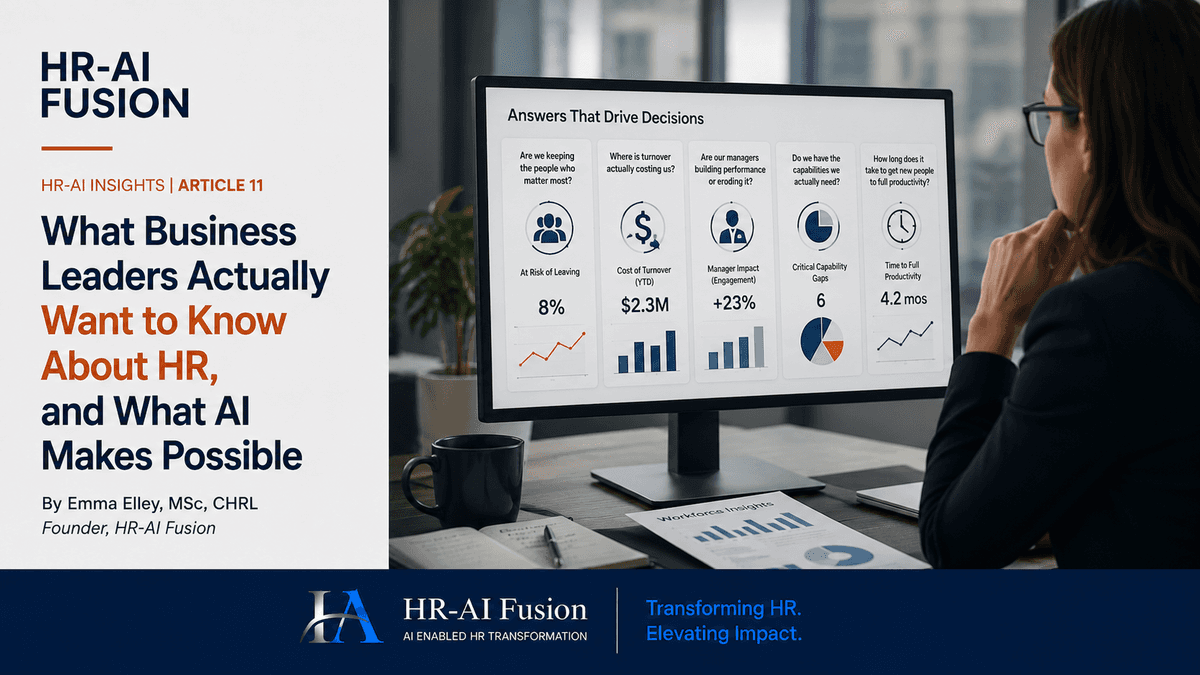
Are We Keeping the People Who Matter Most?
Retention metrics in many organizations measure who left. They do not measure whether the right people stayed. Voluntary turnover at five percent can look healthy while the organization quietly loses five of its most capable people and retains everyone else.
AI can shift this from a retrospective measure to a forward-looking one, identifying which employees show early indicators of disengagement or flight risk based on patterns in performance data, engagement signals, and tenure, before the resignation arrives. The business question is not just how many people left. It is who is at risk right now and what is driving it.
Where Is Turnover Actually Costing Us?
Turnover costs are almost always underestimated, because organizations tend to measure only the visible costs, recruitment fees, notice periods, immediate productivity loss. The less visible costs, institutional knowledge that walks out, the drag on team performance during a vacancy, the time a manager loses to rehiring and onboarding, are harder to calculate but often larger. The cost of filling a critical role with the wrong person is harder still to quantify, and often the most expensive outcome of all.
AI can help organizations build a more complete picture of where attrition is most expensive, by role, by team, by manager, and by the point in tenure when it most commonly happens. That picture changes the conversation from how do we reduce turnover in general to where does reducing turnover have the most business impact.
Are Our Managers Building Performance or Eroding It?
Manager quality is one of the most consequential and least measured variables in organizational performance. The research is consistent: the single biggest driver of employee engagement, retention, and productivity is the quality of the direct manager. And yet many organizations have almost no systematic way of assessing manager effectiveness at scale.
Recent Betterworks research found that 90 percent of HR leaders say AI has already changed what a high performer looks like, yet fewer than half of organizations have updated their performance management criteria to reflect how AI is changing the nature of work. That gap is most visible at the manager level, where coaching employees through AI adoption requires managers to have meaningfully adopted it themselves, and many have not.
AI makes it possible to surface patterns in team-level data that correlate with manager quality: engagement trends within teams, internal mobility rates, performance distribution, and retention relative to organizational averages. None of this replaces the judgment call about an individual manager, but it gives HR and leadership a starting point that is grounded in data rather than reputation.
Do We Have the Capabilities We Actually Need?
The capability question is not about whether the organization has enough people. It is about whether the people it has can do what the strategy demands, and whether that is changing faster than the organization can track. For organizations scaling quickly, the question becomes more pointed: will our leadership hold up as we grow, and where are the capability gaps that will slow us down before we see them coming?
AI can support a much more dynamic view of capability than traditional skills audits allow, drawing on performance data, learning activity, role changes, and project outcomes to build a picture of where capability is genuinely strong and where gaps are developing. The business question is not what training did we run. It is do we have what we need for what is coming.
How Long Does It Take Us to Get New People to Full Productivity?
Time to productivity is one of the metrics business leaders care most about and HR measures least consistently. The cost of a vacancy is understood. The cost of a new hire operating at partial capacity for three, six, or nine months is much harder to quantify, and much more variable across managers, roles, and onboarding experiences.
AI can help organizations track early performance indicators more systematically and identify which onboarding experiences and manager behaviors are associated with faster integration. If bringing someone to full productivity takes twice as long under one manager as another, that difference has real business consequences that rarely appear in any report.
What This Means for HR
HR Executive research found that 40 percent of HR leaders are uncertain about their AI strategy and three quarters are dissatisfied with their current tech stacks. That gap between where the tools are and where the measurement needs to go is real, and it is exactly where the foundations matter.
Answering these business-facing questions well requires good underlying data and HR professionals who can interpret what the numbers mean in context and translate them into language that drives decisions. AI does not make HR measurement automatic. It makes the right measurement significantly more achievable for teams that have the foundations in place.
The difference between an HR function that earns a seat at the table where decisions are made and one that remains a reporting function is whether it can answer the questions leadership is already concerned about, before they have to ask.