
What AI Implementations Reveal About How Organizations Handle Change
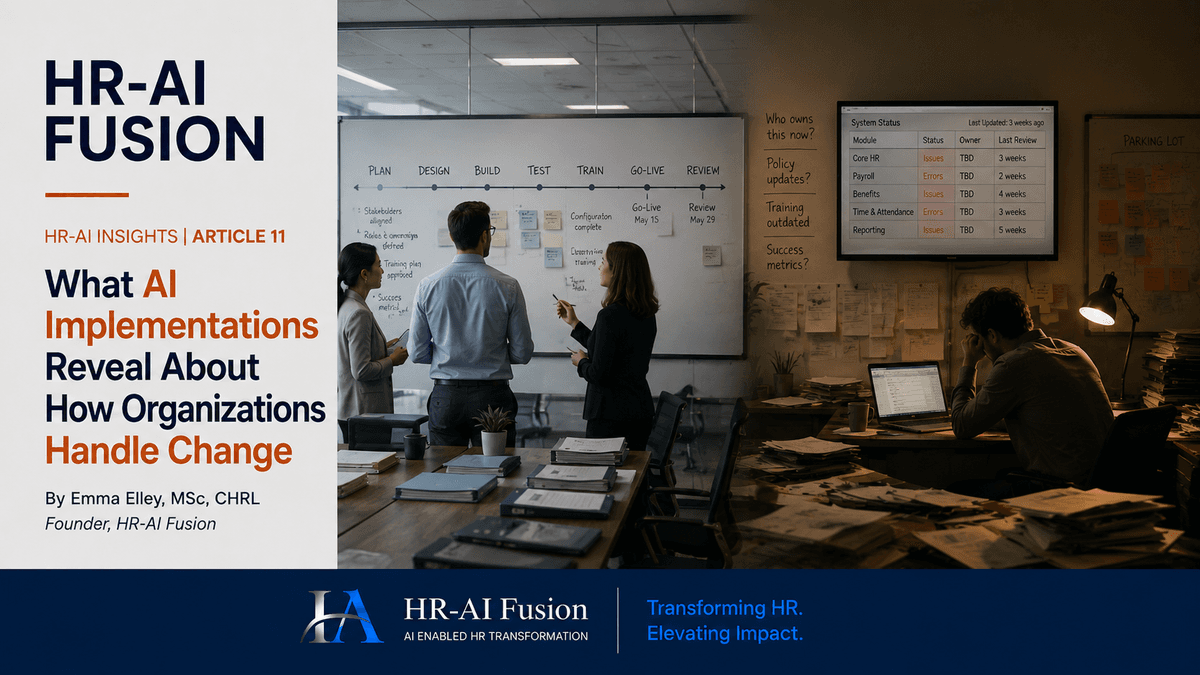
AI implementations reveal something most organizations prefer not to examine too closely about how they handle change.
At HR-AI Fusion, we work with HR leaders and growing organizations to build that discipline before it is tested by something going wrong.
Last week the series covered the three conversations HR leaders need to have before selecting any HR technology. This week looks at what happens after the selection is made, when implementation actually begins, and why so many implementations fail regardless of how good the original decision was.
Most HR technology implementations that fail are not failed by the technology. They are failed by the structure and processes around it. The system does roughly what the vendor said it would do. What goes wrong is everything that was supposed to happen around the system: the change management, the training, the clear ownership, the agreed definition of success.
That has been true for HR technology long before AI entered the picture. AI does not introduce a brand new category of failure. It makes some of the old failure modes worse, and it adds one that genuinely did not exist before.
The Classic Causes, Briefly
The familiar list is familiar because it keeps happening. Change management gets treated as a communications task rather than a behavioral one. Ownership is assumed rather than assigned, which we covered directly in the last two articles. Training happens once, at launch, and is expected to last for years. Nobody agreed in advance what success would actually look like, so six months later there is no shared way to judge whether the implementation worked.
These causes apply to AI implementations just as much as they apply to a payroll system migration. What is different with AI is what happens after they are addressed, not instead of them.
What AI Changes: Implementation Never Actually Ends
Traditional HR software, once configured, behaves consistently. You set it up, you test it, you go live, and the system does the same thing in month twelve that it did in month one unless someone deliberately changes it.
AI systems do not hold still in the same way. The model the vendor uses evolves. The policies the AI was configured against change as legislation and internal practice shift. The governance work from two weeks ago, defining ownership, review pathways, escalation, and maintenance, is not a one-time setup task. It is an operating responsibility that has to be sustained for as long as the system is in use.
This means go live is not the finish line implementation projects have traditionally treated it as. It is the point where a new, ongoing operating responsibility begins. Organizations that treat AI implementation the way they treated their last HRIS rollout, intense effort followed by a return to business as usual, are setting up a failure that will not show up for several months, once the configuration has quietly drifted away from what the organization actually needs.
What AI Changes: Trust Works Differently
People extend a different kind of trust to AI-driven outputs than they do to traditional software, and that difference cuts both ways.
Some employees and managers are more skeptical of an AI-generated recommendation than they would be of the same recommendation coming from a deterministic system or a human decision-maker, even when the AI's reasoning is sound. A technically excellent implementation still fails in practice if the people expected to act on its outputs do not trust it enough to use it.
The opposite failure is just as real, and arguably more dangerous. Some people extend too much trust to AI output precisely because it sounds confident and well-formatted, and they stop applying the scrutiny they would apply to a colleague's recommendation. This is exactly why the explainability question matters as much as it does. An implementation succeeds when people trust the system the right amount, enough to use it, not so much that they stop checking it.
What Organizations That Succeed Do Differently
The organizations that get HR technology implementations right are not necessarily the ones with the most sophisticated tools. They are the ones that build the review cycle and the ownership structure into the launch plan from day one, rather than treating those as cleanup work to handle if problems surface later.
Practically, that means the same questions raised in the last two articles get answered before launch, not after: who owns this, what gets reviewed and how often, what happens when the policy it was built against changes, and what the plain-language explanation for any given output actually is. It also means setting an explicit, shared definition of what success looks like at three months and at twelve months, so that the conversation about whether the implementation worked is not happening for the first time once something has already gone wrong.
Implementation, treated this way, is not a project with an end date. It is the start of a discipline the organization commits to maintaining.
Where to Start
The honest starting point is an internal question: could your team answer the governance questions from the last two articles clearly, right now, without needing to check with someone else? If the ownership, review pathways, and escalation structure are not named and documented, that is where the discipline needs to be built, before the next implementation begins or while the current one is still in progress.