← Back to the HR-AI Insights Series
HR-AI INSIGHTS
The HR Operating Model Was Already Broken: AI Just Made It Visible.
Emma Elley, MSc, CHRL
Founder, HR-AI Fusion · May 1, 2026
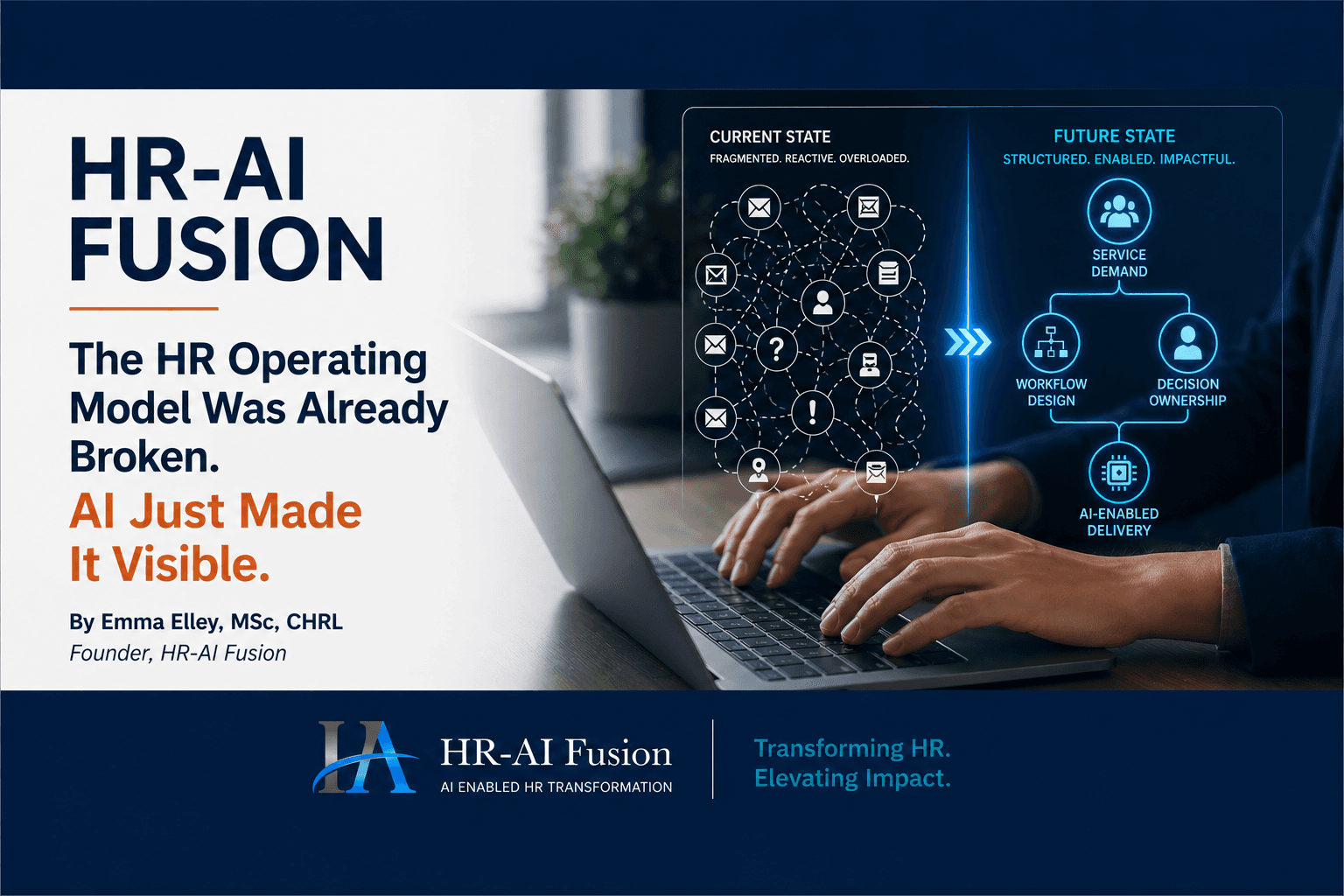
There is a conversation happening in boardrooms and HR leadership teams right now that goes something like this: “We need to figure out our AI strategy so we don’t get left behind.”
It is the wrong conversation. Not because AI strategy doesn’t matter. It does. Last week I argued the first question every HR leader needs to answer is what their function is actually for. This week is about what happens when you try to answer it.
In most organizations, the urgency being directed at AI is really urgency about something that has been true for a long time, something that AI has simply made impossible to ignore.
The HR operating model was already broken. AI just made it visible.
What a Broken Operating Model Actually Looks Like
A broken HR operating model does not announce itself. It reveals itself gradually, through patterns that become so familiar they stop registering as problems.
HR leaders that spend the majority of their time on operational and transactional issues rather than strategic partnership, HR specialists producing policies and frameworks that never quite reach the people who need them, and teams buried in query volume, unable to provide the response times employees expect. Technology systems that were implemented to solve one problem and quietly created three others.
None of this is the fault of the HR professionals working within these structures. It is the fault of the structures themselves: operating models designed for a different era of work, a different volume of employee demand, and a different set of expectations about what HR should be able to deliver.
For years, organizations managed this quietly. HR teams worked harder and priorities were continually juggled. As the gap between what HR was meant to do and what it could realistically deliver widened, the team took it on, often without visibility.
Then AI arrived, and suddenly every executive wanted to know: what is HR doing about it?
Why AI Is Driving a Conversation HR Has Avoided
Here is what the arrival of AI has done that nothing else quite managed: it has put the question of HR capacity and operating model design on the executive agenda.
When a CEO asks how AI will change the HR function, they are unknowingly asking a more fundamental question: what does the HR function actually do, and is that the right use of its time?
The answer, in most organizations, is that a significant proportion of HR activity is transactional, repetitive, and rule-based. It is exactly the kind of work that AI-enabled service models can handle at scale. The conversation about AI becomes, unavoidably, a conversation about operating model redesign.
If you look more closely, this is not just a question of capacity. It is a question of how HR work is structured. Most HR functions are not short on strategic intent. They are short on the capacity required to deliver it.
Most HR functions are operating across three types of work.
Execution work: High-volume, repeatable, rules-based.
Advisory work: Business-facing, judgement and decision support, including strategic work.
Specialist work: Deep expertise, design and problem-solving.
Every function has all three. The difference is whether they are deliberately designed. In many organizations, they are not. Execution work is not clearly absorbed or managed. It flows directly into the advisory layer. So the roles that are intended to operate at a more strategic level become consumed by day-to-day demand.
This is where operating model conversations often miss the point. They focus on structure, roles, or technology, but the underlying issue is how work actually flows through the function. If the execution layer is not designed properly, the advisory layer will absorb it by default.
This is also why this cannot be solved through role redefinition alone. Renaming roles or reshaping titles without changing how work is structured simply repackages the problem. A different outcome requires organizational commitment to the operating model itself, and investment in the capability of the HR team to operate within it.
This is not a threat to HR. It is an opportunity that the profession has not had before: a technology-driven imperative to finally build the operating model HR has always needed, and a business case for doing so that resonates well beyond the HR function itself.
The Mistake Most Organizations Are Making
Given this opportunity, you might expect organizations to approach AI with genuine strategic intent: assessing the current operating model, identifying where AI creates the most value, redesigning service delivery around a future-state capability model, and investing in the HR team’s ability to operate within it.
Most are not doing this. Most are doing one of two things. They are deploying AI tools within the existing operating model, hoping that automation will solve a capacity problem that is actually a design problem. Or they are waiting, paralyzed by uncertainty, while the gap between their HR function’s capability and organizational expectation continues to widen.
Both responses treat AI as the primary variable but it is not. The operating model is the primary variable and AI is the accelerant.
An organization with a well-designed HR operating model and thoughtfully deployed AI will see transformational results. An organization with a broken operating model and the same AI tools will see faster, more expensive, and more visible dysfunction.
Where to Start
The question is not: what AI tools should HR adopt?
The question is: what does excellent HR service delivery look like for this organization, and what operating model, capability base, and technology infrastructure would make that possible?
Answer that question honestly, and the AI decisions largely make themselves. The high-volume, low-complexity work becomes obvious territory for AI-enabled service agents. The strategic work that requires human judgment, contextual knowledge, and organizational relationships becomes equally obvious as the domain where HR professionals add irreplaceable value.
The organizations that will get this right are the ones willing to look clearly at what their HR function is actually doing today, hold it against what it should be doing, and close that gap with intention rather than experimentation.
AI is available to help, but it cannot do the thinking for you.
Emma Elley is the Founder of HR-AI Fusion, a professional services firm specializing in HR transformation, AI-enabled HR service models, and workforce systems modernization. She is a former Chief Human Resources Officer with experience spanning healthcare, financial services, and consumer goods. Learn more at hraifusion.ca.
P.S. Last week's piece, on the one question to ask before introducing AI into HR, is here: https://www.hraifusion.ca/hr-ai-insights/before-you-introduce-ai-into-hr.
Published in HR-AI Insights by HR-AI Fusion. May 1, 2026.
TAKE THE NEXT STEP
Assess your readiness
The HR-AI Readiness Snapshot provides a structured view of your organization's readiness across six core domains: a useful starting point before a first conversation.
Or if you are ready to discuss your context directly, we can help you identify the right starting point and move forward with confidence.