← Back to the HR-AI Insights Series
HR-AI INSIGHTS
Before You Introduce AI into HR, Ask Yourself This One Question
Emma Elley, MSc, CHRL
Founder, HR-AI Fusion · April 24, 2026
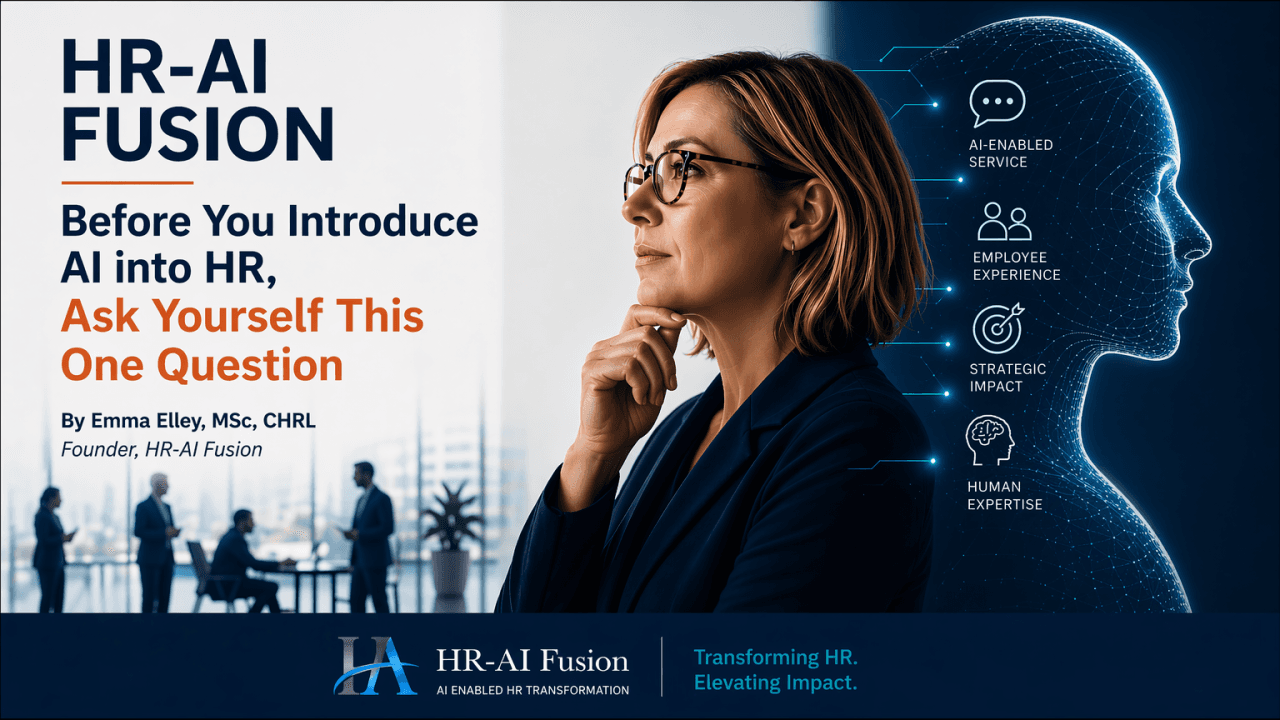
Every HR leader I speak with right now is somewhere on the same spectrum. At one end: eager to move fast, worried about being left behind, convinced that deploying an AI chatbot is the answer. At the other end: deeply skeptical, protective of the human nature of HR, concerned that technology will erode something that matters.
Both instincts are understandable. Neither is quite right.
The question I ask organizations before we do anything else is this:
What is your HR function actually for?
Not what it does day-to-day. Not what it's measured on. What it exists to do. Because the answer to that question determines everything about how, where, and whether AI belongs in your HR operating model.
The Volume Problem No One Talks About Honestly
Here is a reality most HR leaders know but rarely say out loud: a significant proportion of what HR spends its time on is not strategic. It is transactional. It is repetitive. It is high-volume, low-complexity query handling that consumes capacity that was never meant to be consumed this way.
Policy questions. Leave balance enquiries. Onboarding paperwork. Benefits explanations. Process guidance. These are not unimportant: employees need accurate, timely answers, and the experience of getting them matters. But they do not require a skilled HR professional to deliver.
AI-enabled service agents can handle this volume, at scale, consistently, and around the clock. Not as a replacement for HR. As infrastructure, the kind of infrastructure that should have existed long before now, but didn't, because the technology wasn't ready.
The strategic case for AI in HR is not about doing more with less. It is about redirecting human expertise toward the work that actually requires it: organizational design, workforce planning, culture, leadership capability, complex employee relations. The work that changes how an organization performs.
Why Most AI Implementations in HR Fall Short
Organizations are moving quickly. Too quickly, in many cases, and in the wrong direction.
The most common mistake I see is deploying AI as a tool within a broken process, rather than as a catalyst to redesign the process entirely. You cannot layer automation over a fragmented HR service model and expect transformation. You get faster fragmentation.
The second mistake is separating AI implementation from HR operating model strategy. Technology decisions made without a clear picture of the target operating model will produce solutions that optimize the wrong things. An AI that speeds up a process HR shouldn't be doing at all is not an improvement.
The third mistake, and perhaps the most consequential, is treating AI adoption as a technology project rather than an organizational change initiative. AI introduces new employee experiences, new expectations, new accountability structures. If HR is deploying AI tools that employees interact with, those tools are the face of the HR function. The design, governance, and quality of those tools reflect directly on HR's credibility.
What Getting It Right Actually Looks Like
Organizations that are doing this well share a few characteristics.
They start with operating model clarity. Before selecting a technology, they have defined what HR is responsible for, at what level of service, and what capabilities are needed to deliver that. AI is then deployed in direct service of that model, not ahead of it.
They treat AI-enabled service delivery as a discipline, not a feature. The design of conversational agents, the accuracy and currency of the knowledge they draw on, the escalation pathways when queries exceed their scope: all of this is owned, governed, and continuously improved. It does not run itself.
They invest in their HR teams as much as their systems. The shift to an AI-enabled HR model changes what HR professionals need to know and do. Organizations that succeed create the conditions for their HR teams to develop new competencies, rather than leaving them to adapt without support.
And they are honest about what AI cannot do. It cannot navigate nuance. It cannot hold a difficult conversation. It cannot exercise judgment in a situation it has never encountered before. Knowing where AI ends and human expertise must begin is not a limitation to manage around. It is a design principle to build in from the start.
The Strategic Opportunity
We are at an inflection point for the HR profession. The organizations that move thoughtfully, redesigning their operating models, investing in the right infrastructure, and deploying AI where it genuinely creates value, will free their HR functions to do work that has strategic consequence.
The organizations that move carelessly, or not at all, will find themselves in the same place five years from now: HR teams buried in transactional volume, talented professionals underutilized, and a function that struggles to make the case for its own relevance.
AI is not the future of HR. How we choose to use it is.
Emma Elley is the Founder of HR-AI Fusion, a professional services firm specializing in HR transformation, AI-enabled HR service models, and workforce systems modernization. She is a former Chief Human Resources Officer with experience spanning healthcare, financial services, and consumer goods. Learn more at hraifusion.ca.
Published in HR-AI Insights by HR-AI Fusion. April 24, 2026.
TAKE THE NEXT STEP
Assess your readiness
The HR-AI Readiness Snapshot provides a structured view of your organization's readiness across six core domains: a useful starting point before a first conversation.
Or if you are ready to discuss your context directly, we can help you identify the right starting point and move forward with confidence.