The Governance Gap: How to Build Accountability Into Your HR AI Implementation
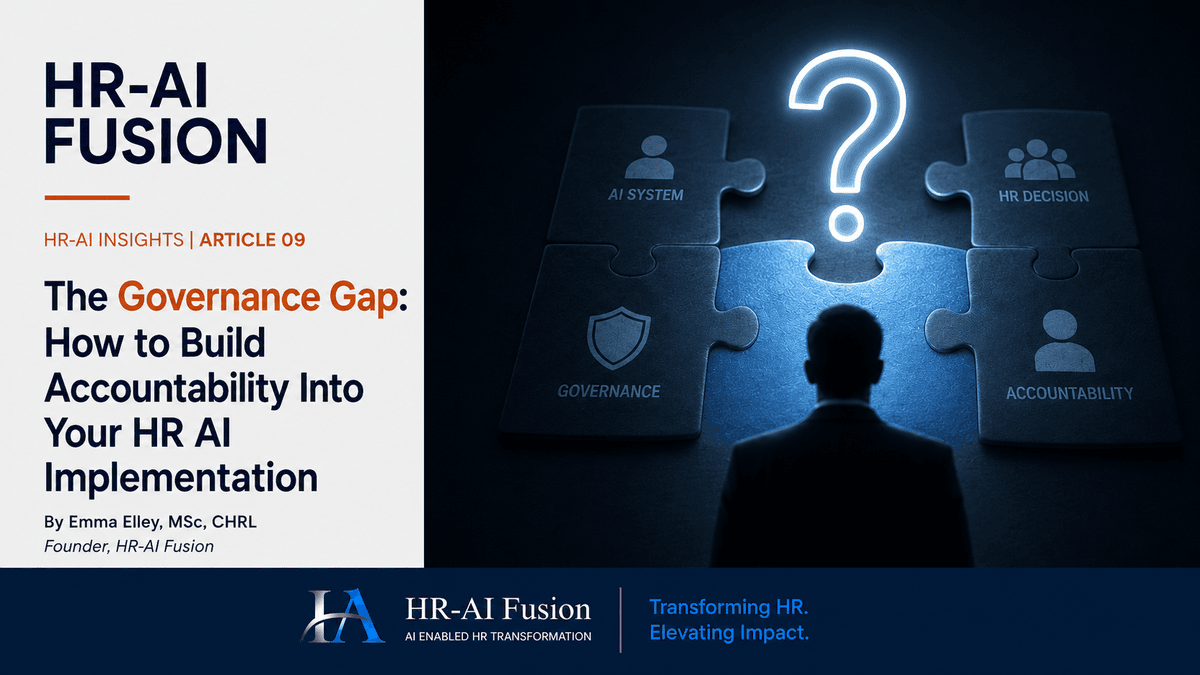
When an AI system influences an HR decision that turns out to be incorrect, inconsistent, or unfair, who is accountable for that? Not in theory. In practice. With a name attached to it.
In most organizations, the honest answer is that nobody has worked that out yet. That gap is not a technology problem. It is a governance problem, and it is one of the most predictable failure points in HR AI implementation.
Last week the series looked at workforce planning and what HR brings to that conversation that Finance and Operations cannot provide on their own. This week the focus moves to governance, which is the part of AI implementation that most organizations plan to get to and never quite do.
Most organizations introducing AI into HR have a technology plan, an implementation timeline, and a budget. Very few have a clear answer to the question that matters most when something goes wrong.
What Governance Actually Means in This Context
Governance gets used loosely enough that it is worth defining precisely before going further.
In an HR AI context, governance means the structures that determine how AI is used, who is accountable for its outputs, how decisions get reviewed, where things go when something goes wrong, and how those structures stay current as tools evolve and policies change. It is not a policy document filed somewhere and forgotten. It is a set of operating decisions that have to be made deliberately and maintained actively.
Good governance does not prevent AI from being useful. It is what makes AI sustainable. Organizations that skip it in the early stages of implementation almost always encounter the same problems later: inconsistent outputs that nobody owns, escalation situations with no clear pathway, and a growing gap between what the AI is doing and what current policy actually says.
The Four Things a Governance Framework Needs to Do
A practical governance framework for HR AI does not need to be complicated, but it does need to cover four things clearly.
It needs to define who owns what. This means naming the people accountable for the AI system's outputs in each HR service area, who is responsible for keeping the content the AI draws from current and accurate, and who has oversight responsibility when something needs to be reviewed or escalated. Accountability that is shared by everyone tends to be owned by no one.
It needs to establish how decisions get reviewed. Not every AI output requires human review before it is acted on, but the framework needs to be explicit about which ones do. High-stakes decisions in performance, compensation, and employee relations carry different review requirements than a policy question about leave entitlements. That distinction needs to be designed into the operating model, not left to individual judgment in the moment.
It needs a clear escalation pathway. When the AI produces a result that does not feel right, when an employee disputes an output, or when a situation arises that the system was not designed to handle, there needs to be a named process for what happens next. Escalation pathways that are vague in design become chaotic in practice, particularly in sensitive situations where getting it wrong carries legal or reputational risk.
It needs a maintenance process. HR policies change. Legislation changes. Organizational priorities shift. The governance framework needs a regular review cycle that keeps the AI's operating boundaries aligned with current policy, and a process for updating it when material changes occur.
What Most Organizations Actually Have
The gap between what governance should look like and what most organizations have in place is significant.
The most common pattern is that governance exists informally, embedded in the knowledge of one or two people who were involved in the implementation and understand how the system works. That is not governance. It is dependency, and it creates fragility. When those people move on, when questions arise that need answers quickly, or when something goes wrong and accountability is needed, the informal arrangement breaks down.
The second most common pattern is documentation that exists but is not actively maintained. The policies and boundaries were defined at implementation. Nobody has reviewed whether they still reflect current practice. The system is operating against a set of parameters that may be months or years out of date.
Neither of these is a failure of intent. They are the natural result of implementing AI without building governance in from the start, which is what most organizations do because governance feels like a constraint on speed rather than a condition for sustainability.
Where to Start
The starting point for most organizations is an honest audit of what they currently have. That means asking who could answer the governance questions above clearly, right now, without needing to check with someone else. If the answer to any of them is uncertain, that uncertainty is the starting point.
For organizations that want a structured view of where they stand across governance and the other dimensions of HR AI readiness, the HR-AI Fusion HR-AI Maturity Diagnostic™ gives you a scored assessment across six domains, with governance as a dedicated focus area. It is designed for HR leaders and the executives working alongside them, and it produces a clear picture of where the foundations are in place and where the gaps are before they become problems.
If you are earlier in the process and want a shorter starting point, the HR-AI Readiness Snapshot covers governance at a higher level and takes around four minutes to complete.