← Back to the HR-AI Insights Series
HR-AI INSIGHTS
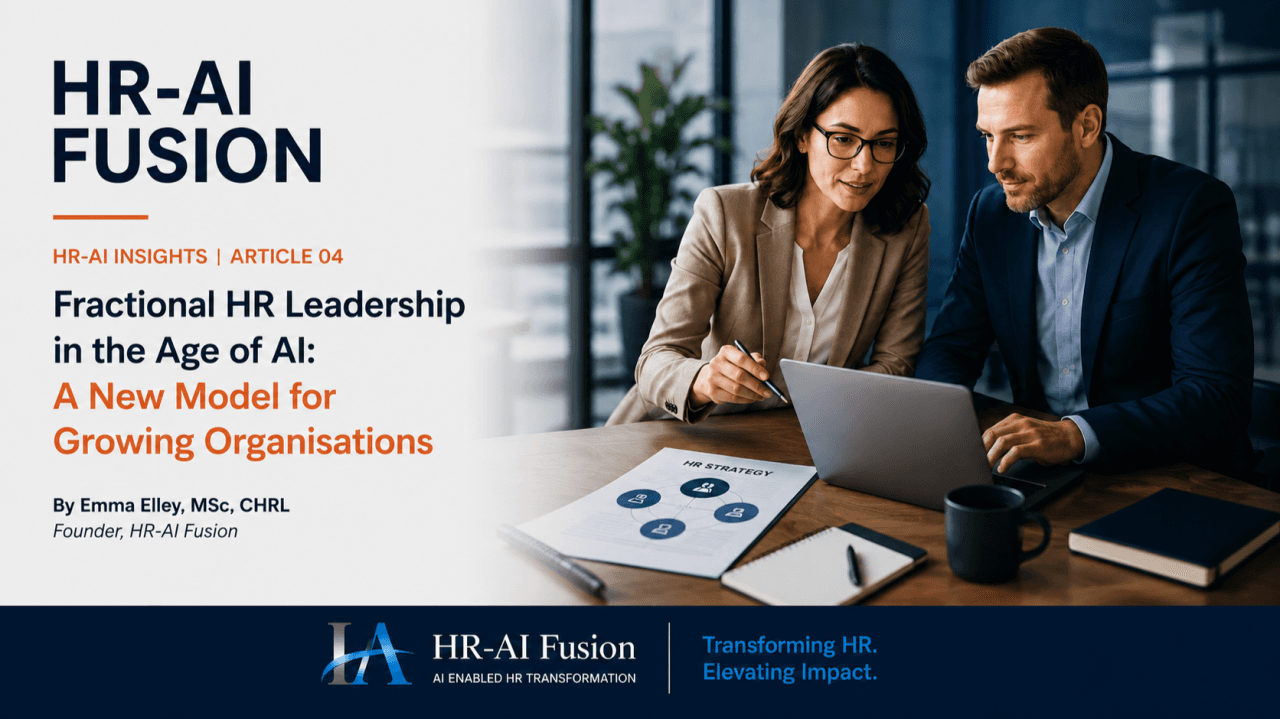
Fractional HR Leadership in the Age of AI: A New Model for Growing Organizations
Emma Elley, MSc, CHRL
Founder, HR-AI Fusion · May 15, 2026
The last three weeks have been about established HR functions. The operating model, HR-AI service agents, and what AI actually does inside HR teams that already exist.
This week is different. This one is for the organizations that do not have a formal HR function yet, or they have someone trying to do HR alongside three other responsibilities, or have just crossed the headcount threshold where informal people management is quietly becoming a risk.
The question is not how to modernize HR. It is how to build it without making expensive mistakes along the way.
The signal worth paying attention to
Most organizations do not wake up one morning and decide they need an HR function. They get there because something stops working. The signals tend to be recognizable:
- Leadership time is being absorbed by people issues that should not require founder or executive involvement.
- New hires are being onboarded inconsistently, depending on which manager they report to.
- There is no policy framework, or what exists has not been maintained.
- Managers are making performance, compensation, and conduct decisions without a clear structure or understanding of employment risk.
- Compliance obligations are accumulating that no one has the expertise to assess or address.
Any one of those on its own is manageable. Several together, in a growing organization, means HR has effectively come off the rails without anyone quite naming it that way.
Why the standard options do not solve the problem
When organizations recognize this, they usually reach for one of three solutions.
They hire a junior HR coordinator who is capable and well-intentioned but in over their head from day one, because what the organization actually needs is senior HR judgment, not someone to process paperwork.
They bring in a consultant who delivers a policy document or a report and then disappears. The deliverable sits in a folder and nothing changes.
Or they keep absorbing it themselves, which is the most expensive option of all, because it costs founders and senior leaders time they do not have, on problems that are not going away.
Fractional means a fraction of their time. It does not mean a fraction of their capability.
A fractional HR leader is a different approach. It is not a junior hire or a consultant handing over a document. It is a senior HR leader embedded in the organization, working directly with founders and leadership, typically one to two days per week.
What the engagement actually covers
Each fractional engagement follows a structured path. The specifics vary by organization, but the logic is consistent.
It starts with a clear assessment of where HR risk is concentrated and what is being absorbed by leadership that should not be. That establishes the priority order and shapes everything that follows.
From there, immediate HR leadership on the decisions already in motion. The most urgent issues get addressed first, and a clear decision-support structure gets established for managers so they are not operating without guidance.
Then the core infrastructure: a policy framework, consistent onboarding, performance and conduct structures, and the governance needed to make people decisions reliably and with confidence.
Finally, putting in place the operating model, manager capability, and governance to sustain it as the organization grows. The goal is an HR foundation that does not depend on me to function. Some organizations reach that point and are ready to operate independently. Others find the model works well and choose to maintain the arrangement. And for some, they may choose to implement AI-enabled tools, which are handling routine employee volume, and for them the right next step is bringing in a more junior HR resource, at which point I can help identify and hire the right person, and remain available as a mentor or senior resource when more complex situations arise.
The exit looks different for every organization. What stays the same is that the work is always pointed toward a foundation that holds.
What AI changes about this model
The traditional fractional arrangement has a ceiling. A senior leader working part-time can only cover so much ground. Transactional volume, routine employee questions, process administration take time, and time is the constraint.
AI-enabled tools change that constraint in a specific way.
When routine employee questions are handled by an HR AI service agent, when workflows are automated, when documentation is generated rather than written from scratch each time, the fractional leader's available capacity shifts. The time that would have gone to routine demand goes instead to the work that requires senior judgment.
This is how HR-AI Fusion is built. Fractional engagements are designed from the outset to pair senior HR leadership with AI-enabled capacity where it makes sense. The result is more strategic work, more consistently, for an organization that could not otherwise afford to run both in parallel.
For a growing organization, that combination changes what is achievable. You can build an HR function that operates above your size, without the cost of building a full team to run it.
Who this is actually for
Not every growing organization is ready for this. The ones that get the most value tend to share a few characteristics.
They are past the point where informal people management is working, or they can see they are approaching it.
They have a founder or senior leader who will be a genuine partner in building the function, not someone who hands over a problem and expects it to be solved in isolation.
They want to build something that lasts, not a stopgap that creates a different set of problems six months later.
If that is where you are, a short conversation is the right first step. A conversation about where things stand, whether this model makes sense for your situation, and what a sensible starting point looks like.
Most organizations that get HR right at this stage do not have more resources than the ones that do not. They make better decisions earlier.
Emma Elley is the Founder of HR-AI Fusion, an HR consulting and AI-enabled service delivery practice based in Ontario, serving organizations across Canada. She is a Fractional Human Resources Leader with over a decade in the Canadian healthcare system and earlier experience in financial services, manufacturing, and consulting. Learn more at hraifusion.ca.
P.S. Last week's piece, on what HR service agents actually do and where they do not belong, is here: https://www.hraifusion.ca/hr-ai-insights/what-hr-service-agents-actually-do.
Published in HR-AI Insights by HR-AI Fusion. May 15, 2026.
TAKE THE NEXT STEP
Start with a conversation
If you are a growing organization thinking about what HR should look like for your stage, the right starting point is a short, no-obligation conversation about where things stand and what a sensible first step looks like.
Or take the HR-AI Readiness Snapshot first for a structured view of where your organization stands across six core domains.